The proof gap: why European plastics regulation arrived before the evidence infrastructure
The number that should worry a compliance team
Around 353 million tonnes of plastic waste were generated worldwide in 2019, and roughly 9 per cent of it was recycled (OECD, Global Plastics Outlook, 2022). The number that is missing is how much of what is recovered can actually be evidenced. Most recovery operations cannot yet produce it.
That is the part that matters, and it is not only a recycling problem. A great deal of material is recovered and reprocessed. What is missing is not always the activity. It is the ability to demonstrate, to a third party who was not there, that the activity happened, at that volume, with that material, through those hands.
That distinction matters more every quarter, because the European regulatory agenda has quietly stopped asking companies to recycle and started asking them to prove it.
That is the gap Plastiks works on. We accredit recovery entities before we accept any data from them, and we verify their records, so that a claim can be checked by someone who was not there. How we verify
What regulation now asks for
Regulation (EU) 2025/40 on packaging and packaging waste began applying on 12 August 2026, on a phased basis. The European Commission published its guidance document in the Official Journal on 10 June 2026 (Notice C/2026/3084). Among its obligations are design for recycling, reduction of over packaging, harmonised labelling and, from 2030 at the earliest, mandatory minimum recycled content in plastic packaging. Every one of those is a claim about material, and every claim about material has to be substantiated. The European Commission’s page on the regulation is a good place to follow its status.
Alongside it, the European Commission is preparing the Circular Economy Act, a framework law. Its expected pillars are a single market for secondary raw materials, harmonised extended producer responsibility across member states, and European end of waste criteria. Note that it is not in force. It is in preparation, and anyone telling you otherwise is selling something.
Outside the European Union the direction is similar. The United Kingdom and India run producer responsibility schemes for packaging and plastic waste, and a growing number of countries in Latin America and Africa have introduced or are developing their own. The specifics differ. The underlying demand does not: tell us what was recovered, where it came from, where it went, and show us.
Three things break at the same moment
Spreadsheets carry no chain of custody. A figure in a cell is an assertion. It cannot be reconstructed under scrutiny, because the documents that produced it live in other systems, other inboxes and other companies. When an auditor asks how a number was arrived at, the honest answer in most operations is a reconstruction exercise that takes weeks.
Unsupported claims carry regulatory risk. A statement that cannot be substantiated is no longer only a reputational question. Environmental claims without evidence are increasingly a compliance matter, not only a public relations one. The calculation that used to favour a confident round number now favours a defensible one.
Filings are drifting toward structured data. Producer responsibility reporting is moving from annual declarations toward structured submissions. Fragmented records cannot produce structured submissions without a reconciliation step that many operations have not budgeted for.
Why certification alone does not close the gap
The instinctive answer is to certify. Get a scheme, get a logo, move on.
That answer got harder this year. At the PREVENT Waste Alliance Plastics Working Group in November 2026, an analysis of certification systems for recycled plastics was presented. The overall message was that the systems differ widely in what they certify and how, and that the transparency and credibility of some of them cannot be taken for granted.
That is not an argument against certification, and we are not making one. It is an argument that a certificate is itself a claim. A claim needs evidence underneath it, and the evidence has to be checkable independently of the body that issued the certificate. If a scheme disappeared tomorrow, would the evidence it certified still stand on its own? For a great deal of what circulates in this market, the answer is no.
What an evidence layer actually looks like
The shape of the answer is not complicated, even if the execution is.
Accreditation comes before data. The organisation is assessed before a single kilogram is accepted from it. Entity accreditation and transaction verification are two different controls with different evidence and different frequencies, and conflating them is the most common structural weakness we see.
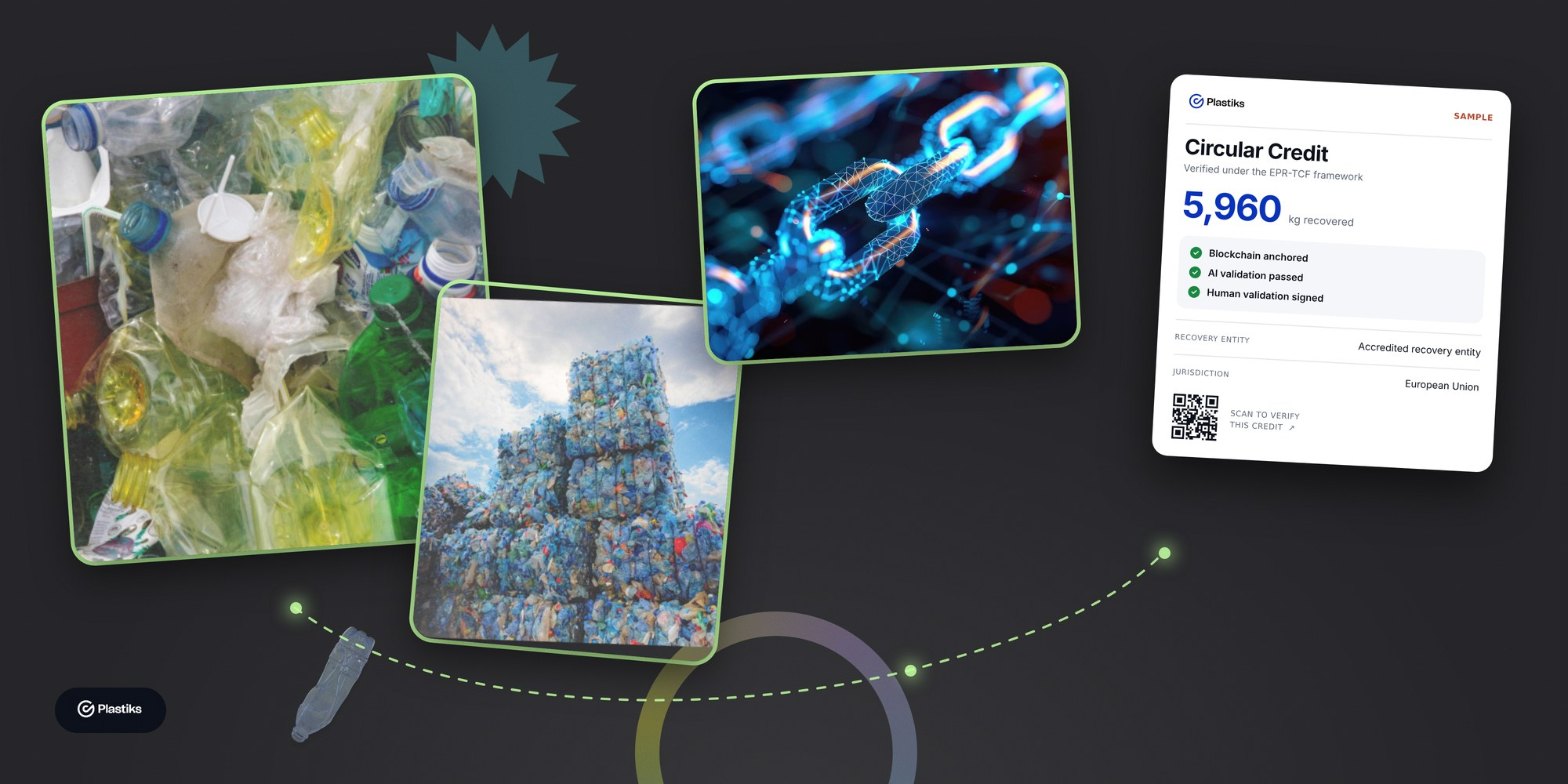
Every claim is built from documents, not declarations. A Credit on our platform rests on proof of origin, proof of transaction and proof of destination. Where the material came from, that it changed hands, where it ended up. All three must reconcile with each other.
Automation reads, a specialist decides. Automated checks screen submissions for gaps, duplicates and inconsistencies. What they produce is a queue of questions, not a verdict. Every flag is resolved by a person who can open the original document and go back to the recycler. An auditor can see which checks were machine made and which were human judgement.
Anchoring comes last. Once a record is approved, it is anchored on Cardano with a public reference. That makes the record tamper evident and independently checkable. It does not make the information true. The evidence underneath does that.
The practical question
If you recover, reprocess or buy recycled material, the question is not whether your operation is good. It probably is. The question is what it produces when somebody who was not there asks for proof.
Open a tonne at random from last quarter. Can you show where it came from, when it moved, who handled it, and where it ended up, from documents that reconcile with each other, without a three week reconstruction? If yes, you are ahead of most of this market. If no, that is the gap, and it is the one regulation is about to price.
Find out what your recovery data would produce under scrutiny. Book an onboarding session with our Methodology and Verification team: andre@plastiks.io. Or see how we verify: plastiks.io/integrity.
Sources
-
Regulation (EU) 2025/40 on packaging and packaging waste, EUR-Lex
-
European Commission, Notice C/2026/3084, guidance document, Official Journal, 10 June 2026
-
European Commission, packaging and packaging waste legislation page
Also referenced: the analysis of certification systems presented at the PREVENT Waste Alliance Plastics Working Group, November 2026, and the Plastiks accreditation methodology.